


12 May 2026 Turning the Table
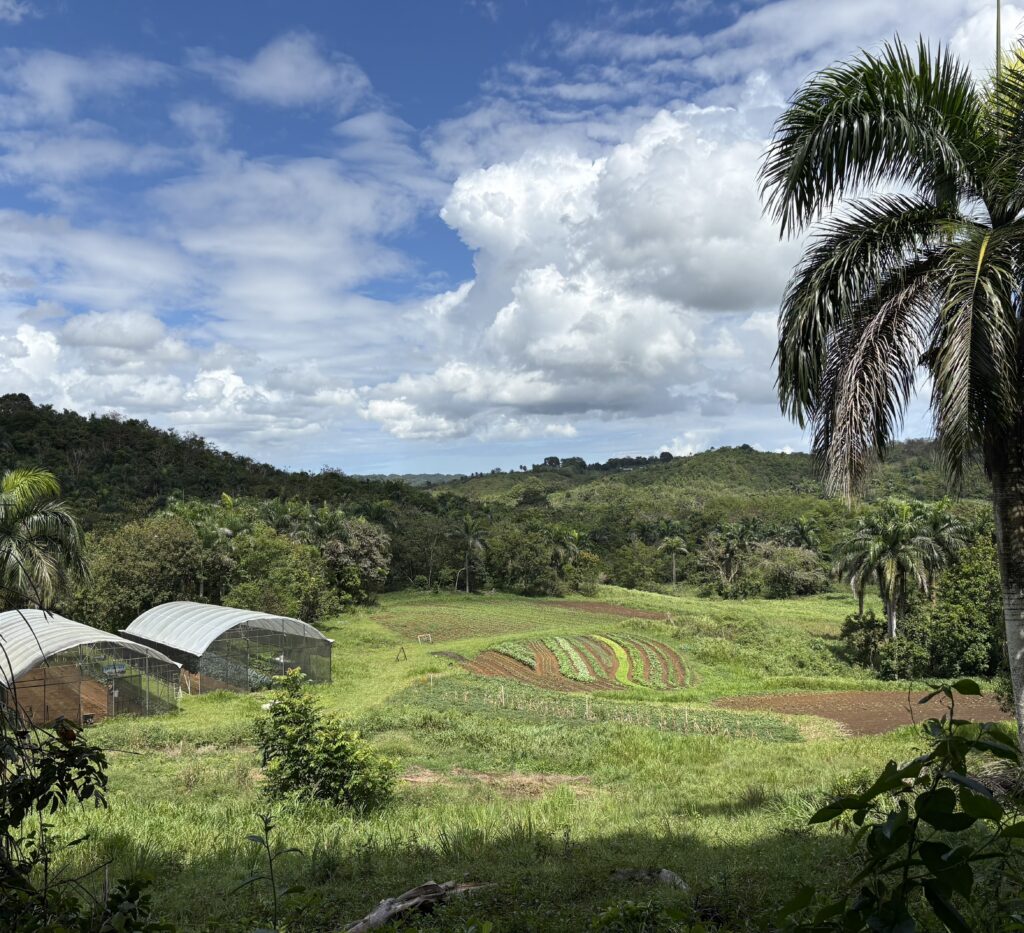
Puerto Rico relies on imports for 85% or more of its food, leaving the island insecure and dependent. Here are sound-rich profiles of three remarkable people, none of whom began in agriculture, each using their own unique backgrounds and skills to help make the island’s food supply–and the lives of its people–more secure. Some music from Blue Dot Sessions.
First Aired: May 12, 2026
Turning The Table – Terrascope Radio 2026 Program Script
[Ian:] Being raised in Puerto Rico, living in Puerto Rico, you always hear about it is part of our colonial, mindset. if you as Puerto Ricans don’t behave well, there will not be food for you. And that’s very powerful.
[Penelope:] Ian and his team did not start out as farmers– they were originally college students.
[Ian:] We were very concerned students about our political situation. About the economic situation? About our environmental situation here in Puerto Rico.
[Penelope:] They lobbied, protested, and pushed for change in the status quo in Puerto Rico. But eventually, they saw opportunity for change in a different way.
[Ian:] So we wanted to put our resources, time, ideas to propose something and to and to build something. Not just always protesting and stepping back. We say that we are building a an army of our agroecological farmers. So right now, 12 years later, there are thousands of people educated like, very highly educated in our ecology because of, as a result of our school, of agroecology, there’s, dozens of new agroecological, projects around the island.
[Penelope:] Ian and his colleagues started as revolutionaries, and that’s not too far from where they ended up. They channeled their love and anger into something that would heal Puerto Rico’s food system from centuries of stigma and exploitation, sharing their knowledge with thousands of people around the island.
[Ian:] In the struggle for a better Puerto Rico, we are proud Puerto Ricans. We have to to establish that we we are proud Puerto Ricans and we think and we know that we, wow. We know that we can do better. And we, nos merecemos mas… we deserve better also. Thank you.
[Jocelyn:] Further south on the island, in a sprawling expanse surrounded by hills, a warm breeze rustles the grass, carrying a dusty, dry aroma through the air. Amidst the avocado trees, another farmer finds herself drawn to the land and the life that comes from it.
[Josefina:] I just want to taste avocado with nothing else. taste? Passion fruit. I mean, everything I plant, I have to love it. Well, I’m glad that I don’t plant things I don’t like. I am Josephina Arce.
[Jocelyn:] And she, along with Betsaida Ortiz, runs a 70-acre farm.
[Josefina:] Well, welcome to Finca Atabey. Atabey is a word in Taino language, which means, Mother Earth.
[Jocelyn:] Her name for her farm, which is in Taino, an indigenous language of Puerto Rico, reflects her connection with the earth, and the passion in her voice overflows as she talks about the food she grows. But surprisingly, she hasn’t been a farmer her whole life.
[Josefina:] I am, ex-professor of chemistry at the University of Puerto Rico in Rio Piedras.
[Jocelyn:] It wasn’t until after she retired that she decided to take up farming.
[Josefina:] I would no longer wanted to have very controlled experiments. I wanted something real.
[Jocelyn:] She’d rather spend her retirement doing hard labor than resting.
[Josefina:] I think I’m maybe you’re a little crazy because, it’s a lot of work. It’s very difficult, but it gives me a sense of of living. Of earth.
[Jocelyn:] Aside from that, Josefina is passionate about other issues that impact Puerto Rico and the rest of the world.
[Josefina:] I went over here to work on this farm because I was very interested in, food sustainability in Puerto Rico. Maybe not to to provide everything, but at least to have something to eat if something happened for a few months.
[Jocelyn:] She’s also committed to combating climate change. She’s concerned about the overuse of chemicals in agriculture, and in general the impact that large-scale farming has on the environment. Despite not being a professor anymore, she regularly conducts research on her farm to innovate alternative farming techniques.
[Josefina:] Oh, God. I didn’t know exactly what I was hoping for because, doing, research, experimenting in a changing environment is extremely difficult, but I love it.
[Jocelyn:] She loves it. So she’s motivated partly by her understanding of science. She’s motivated by her wholehearted desire to produce Super Tasty Food. She’s also motivated by her love for the people around her. Her infectious joy for nature and the land compels her to share it, and she wants more people to see the world in the beautiful way she does.
[Josefina:] I wrote two books this year, this last year. Education is something that I’ve done all my life, and it’s something that I enjoy so much. People say that I teach even if people don’t want to learn, I don’t care. You’re going to hear me and everything that I have to learn first hand, touching the earth and touching the plants. It’s so beautiful. It really makes me sad that people are not enjoying all the beautiful things that the earth is supposed to give us.
[Jocelyn:] So when Josefina grows food, she grows it the way a scientist does. But she also does it with her full nurturing authentic self. With all the love and care in her heart for the earth, and for her people.
[Christian:] While farmers like Josefina are getting their hands dirty, love for food and the island keeps others moving forward in the heart of Puerto Rico in San Juan.
[Crystal:] I love to cook it. I love to grow it. I love to eat it.
[Christian:] But growing the food is only half the struggle… getting the food to the table is just as important. That’s where Crystal Diaz, cofounder of PRoduce, comes in. PRoduce is an online marketplace where people can easily order local produce. To facilitate this, they operate a distribution center where they package and send out orders. This work all started with a question
[Crystal: 00;02;03;07] And when in in the sense that I love food, at some point you get into the question of why we don’t have really good food and why is this happening, why we import so much.
[Christian:] This questioning of Puerto Rico’s flawed food system caused Crystal Diaz to leave her career of 14 years in marketing and business. She realized that what she really wanted in her career was to add value to her homeland.
[Crystal:] I knew at that point that I wanted to focus my efforts into adding value to my country, to my island, and the part that I love is food.
[Christian:] But then… in 2020…. the world changed
[Christian:] As the coronavirus pandemic locked down the entire world, the imports that Puerto Rico relied on began to slow down.
[Crystal:] when the things get hard because there is a pandemic, everybody is going to protect their people, and what we will have? Whatever happens with the country that is producing that food that decides that it will not ship any more food because they’re gonna protect their people, and then we are right here waiting for the ship. That’s not reliable. It’s a fake reliability.
[Christian:] So her goal was simple: she wanted to be a part of the movement working to make a change, no matter how big or small.
[Christian:] Crystal quickly realized that you can’t just build a new food system on a foundation of broken trust. For years, Puerto Rican farmers had been the one to bear the brunt in the food system:
[Crystal:] In the case of the local farmers, there was a lot of trusting issues because a lot of distributors in the past will tell you, “Yes, yes, yes, grow this. I will buy from you.” And then when the crop was ready, they will tell you, “Ah, no, you didn’t have it when I needed it, so I already bought it from someone else.” So for us, it was very important to, like, we have been committed since day one that we will buy your crop if we said that we were going to do it.
[Christian:] Crystal knew she couldn’t run PRoduce by only buying when it’s convenient… she had to be the one to change these relationships. And so Crystal took the risks, time, and dedication to have meaningful connections with the farmers.
[Crystal:] Somebody has to risk, and we have always expected that the farmers is the one that risk. And the way that we see it is that we’re gonna risk it. The farmer should not risk it. That’s how we began most of our relationships, were losing money just buying whatever you had, just to— for you to start trusting us.
[Christian:] During this time, PRoduce established itself to Puerto Rican consumers as an app that not only brought food to their plates, but also lessons about supporting local food and farmers.
[Crystal:] So that what, like, what do you think moving forward is your vision for education and how it can work with this kind of new system that you’re creating? That’s right. Well, I think education is, one of the primary things that we need to do, especially because we cater products that most people have never seen before or have never and haven’t seen in years. So we need to educate a lot about how to use them, how to cook kids, what to use them. I have been having conversations lately of take whatever recipe you want and just substitute the potato with these, these, these, these or that, or just substitute water and take like general ingredients that you can substitute with local stuff and just, giving the people the hint to use other goods that are not necessarily their potatoes and, things that we don’t grow here.
[Christian:] She shows people that consumers don’t need to rely on imported food to create delicious dishes. Spreading awareness and fostering meaningful connections is what drives Crystal.
[Crystal:] So I think in general, what I like most of what I do is that I get to choose what adds value because I have that freedom, what adds value on what I want to do that adds value to to what I believe that should be happening in Puerto Rico instead of our regular job, where I have to do the same thing every day because I have different projects, I just have things to do all the time. But I get to do what adds value? What adds value to you? For me, it adds value, to make more local product available in the tables of the Puerto Rican families in different ways, in a restaurant, in your home, when you’re cooking, buying from more local farmers so people get more, excited to grow more food.
[Christian:] Crystal’s operation in San Juan is growing day by day. It is expanding from just a distribution center to a storefront and community center, a place where Puerto Ricans can hang out and relax, connect with people, and share their love for local food.
[Liam:] Listening to Ian, Josefina, and Crystal, none of these people started in agriculture, but they recognized a problem and learned how to navigate it from scratch, all while leveraging each of their unique backgrounds and skills to push towards a better future, a better Puerto Rico.
[Liam:] Ian didn’t see what he wanted in his education, so he became a teacher himself to empower his students and community.
[Ian (El Josco Bravo):] We are proposing a new kind of farming that provide us dignity, good quality of life.
[Liam:] Josefina approaches agriculture with her scientist’s background, and she puts her whole heart and soul into her work to share her joy for the earth with as many people as possible.
[Josefina (Finca Atabey):] Well, it’s like it’s like having your child or somebody else’s child. It’s just you feel, empowered. You feel, like you’re doing something for yourself that you know where it comes from.
[Liam:] Crystal found instability in distribution with small farmers left hanging, so she strove to build a system of connection, trust, and loyalty.
[Crystal (Produce):] I love to connect people. I love to create networks of people doing really good things together, and supporting our local farmers and getting consumers amazed because they try something the first time. That’s what moves me.
[Liam:] This isn’t just a story about food or the flawed system governing its production and distribution. This is a story about people from all walks of life disrupting that system. But not only that, it’s a story about people driven by community, care, and cultural pride.
Acknowledgements
[Iman:] This piece was produced by the Massachusetts Institute of Technology 2026 Terrascope Radio class.
[Iman:] While gathering sound for this story, we saw this sense of culture and community at Plaza Pública Santiago R. Palmer Square in Caguas, Puerto Rico. Children giggling and running around fountains, old couples dancing hand in hand, and people nodding along to the music that reverberated throughout the square. This is the community, the culture that Ian, Josephina, Crystal, and so many more are committed to. Committed to bettering the future for the people and children dancing along to the music.
[Osade:] Brought to you by Terrascope Radio 2026: Iman Babiker, Stacy Chen, Stephanie Fischer, Liam Gault, James Holmes, Jocelyn Hwang, Osadebamwen John-Nejoh, Christian Le, Anniston Pierce, Wade Rogers, David Sevilla, Penelope Swain, and Jacob Zhao. Terrascope Radio is a class developed by the MIT Terrascope program in collaboration with the MIT Comparative Media Studies program. We would like to thank Terrascope director David McGee and community coordinator Kristin Baker, as well as instructor Ari Epstein and Undergraduate Teaching Fellow Jackson Dryg. We would also like to thank the people and organizations that we spoke to in Puerto Rico. Without these amazing people, this piece would not have been possible. Some music from Blue Dot Sessions. Thank you for listening!